
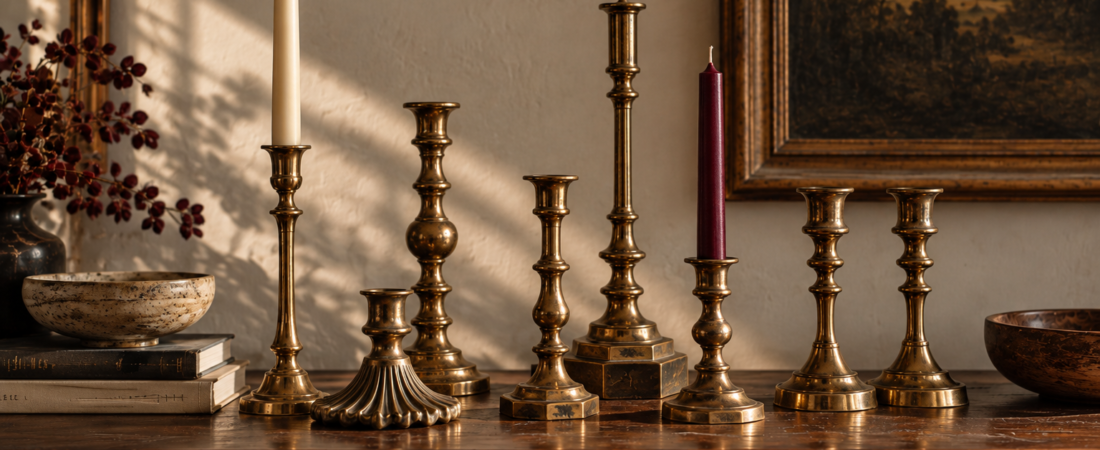
How to spot the shapes, proportions, finishes, and little details that make one brass candlestick far more interesting than the next.
Brass candlesticks are exactly the kind of thing that makes a good Weekend Hunt.
You can find one tucked onto the bottom shelf of a vintage shop, sitting among dozens of similar pieces at a flea market, listed by an independent maker online, or unexpectedly well-designed in the new arrivals section of a regular home store.
And you do not need to be looking for antiques.
The point is not where the candlestick came from. It is whether there is something about it worth noticing.
A beautiful silhouette. An unusually wide base. A stem with just the right amount of curve. A dark, uneven finish that gives the metal depth. Enough weight to make a simple form feel substantial. Or a strange little detail that makes you think about it again after you have walked away.
Once you start looking closely, brass candlesticks stop being interchangeable gold objects and become much more interesting.
This post contains affiliate links. If you make a purchase through one of these links, After Friday may earn a commission at no extra cost to you. As an Amazon Associate I earn from qualifying purchases.
Start With the Silhouette
Before checking the price, wondering how old it is, or trying to work out whether it is solid brass, look at the outline.
A good candlestick should be interesting even in silhouette.
Some are tall and extremely slender. Others have heavy baluster-shaped stems, wide architectural bases, squat chamberstick proportions, or almost modern geometric profiles. There are beautifully plain examples and wildly sculptural ones.
None of those shapes is automatically better.
What matters is whether the form feels intentional.
Try mentally removing the brass color altogether. If the same candlestick were matte black, stone, or drawn as a simple outline on paper, would you still notice its shape?
If the answer is yes, it is probably worth a closer look.
That is often a better first filter than ornament, age, or brand.
Proportion Matters More Than Decoration
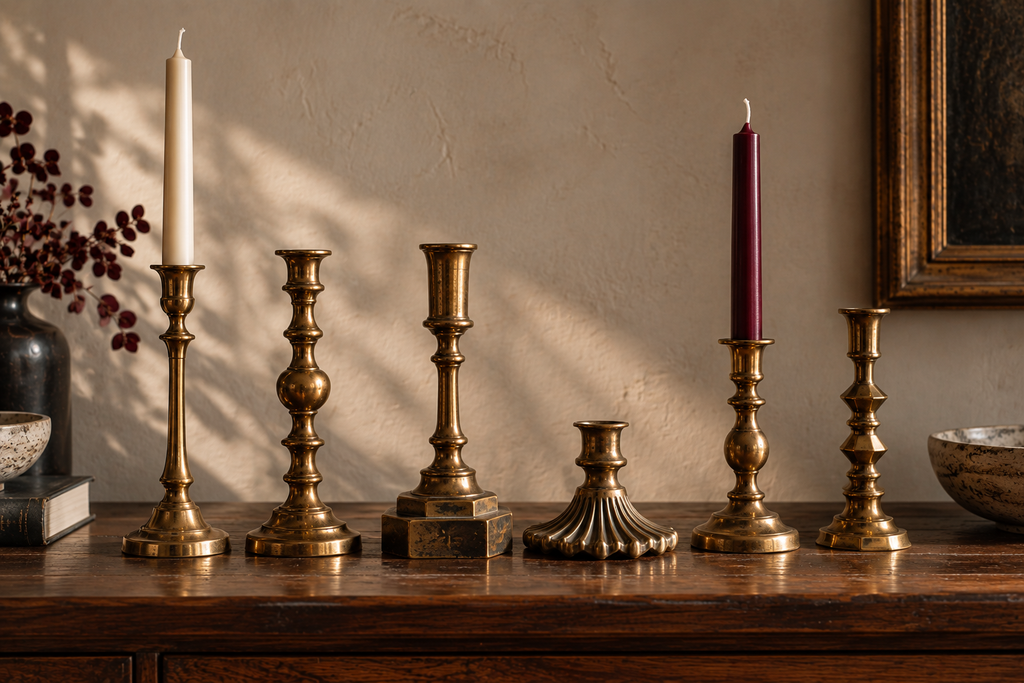
Some of the best brass candlesticks are almost completely plain.
What makes them work is proportion.
Look at how wide the base is compared with the stem. Notice where the stem narrows and widens. Look at the size of the candle cup and whether the top feels too heavy or too small for everything underneath it.
There is a kind of visual balance to a well-proportioned candlestick that is difficult to reduce to a formula but surprisingly easy to recognize once you start paying attention.
A slender stem might need a slightly wider foot to anchor it. A substantial base can support a heavier, more sculptural body. A very tall candlestick often looks better when the transitions in the stem give your eye somewhere to pause.
Ornament can be lovely — fluting, ridges, scallops, engraving, twisted stems — but decoration cannot rescue an awkward underlying shape.
Simple does not mean ordinary when the proportions are right.
Solid Brass Is Worth Knowing About — But It Is Not the Only Thing Worth Buying
Brass is a copper alloy, traditionally associated with its warm yellow-gold appearance, and a piece described as solid brass should be made from brass through its body rather than simply carrying a brass-colored surface layer.
A brass-plated object uses another material underneath with brass applied to the surface.
That distinction matters because wear behaves differently. On solid brass, surface wear still reveals brass beneath. On a plated piece, enough wear can eventually expose the underlying material.
But this is where Weekend Hunt rules differ from collector rules:
Plated does not automatically mean bad.
If an inexpensive plated candlestick has exceptional proportions, a beautiful finish, and exactly the silhouette your collection needs, it can still be a very good find.
Equally, “solid brass” written on a label does not magically make a badly designed candlestick interesting.
Weight can offer a clue when comparing pieces, and visible wear may reveal another metal underneath a plated finish. A strongly attracted magnet can indicate a ferrous metal somewhere in the construction. But no single quick test should be treated as definitive proof of age, quality, or composition.
Buy the object in front of you, not the mythology around it.
Learn to Like Patina Before You Reach for the Polish
Brass does not have to be bright and mirror-polished to be beautiful.
In fact, one of the pleasures of finding older or naturally aging brass is the variation across its surface.
Copper alloys such as brass can develop stable patinas in a range of colors, including gold, brown, black, green, and blue. Darkening on brass can develop gradually through exposure to air, moisture, and environmental pollutants.
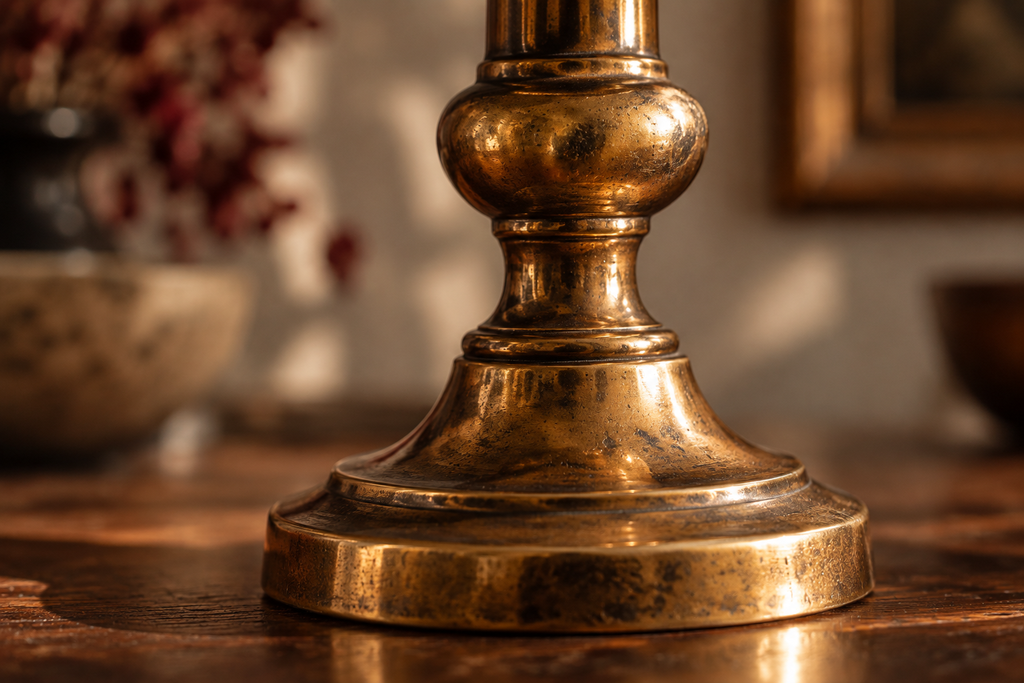
That might mean a deep brown around the base, darker color sitting inside decorative grooves, a softer golden surface where hands have not touched it as often, or years of subtle unevenness that make a piece look much richer than brand-new polished brass.
Patina is not proof that something is antique — finishes can be deliberately aged too — but visually, a good patina can be one of the things that makes a candlestick special.
The important distinction is between a stable, attractive surface and deterioration that is loose, powdery, flaking, or structurally concerning. Conservation guidance distinguishes stable, adherent patinas from active corrosion, which can appear as loose or rapidly developing powdery green deposits.
And think before polishing an older piece simply because brass “should” shine.
Polishing is abrasive: it removes tarnish along with a small amount of surface material, and repeated polishing can gradually soften surface detail.
Sometimes the darker finish is exactly what makes the piece worth keeping.
Look Down: The Base Often Makes the Candlestick
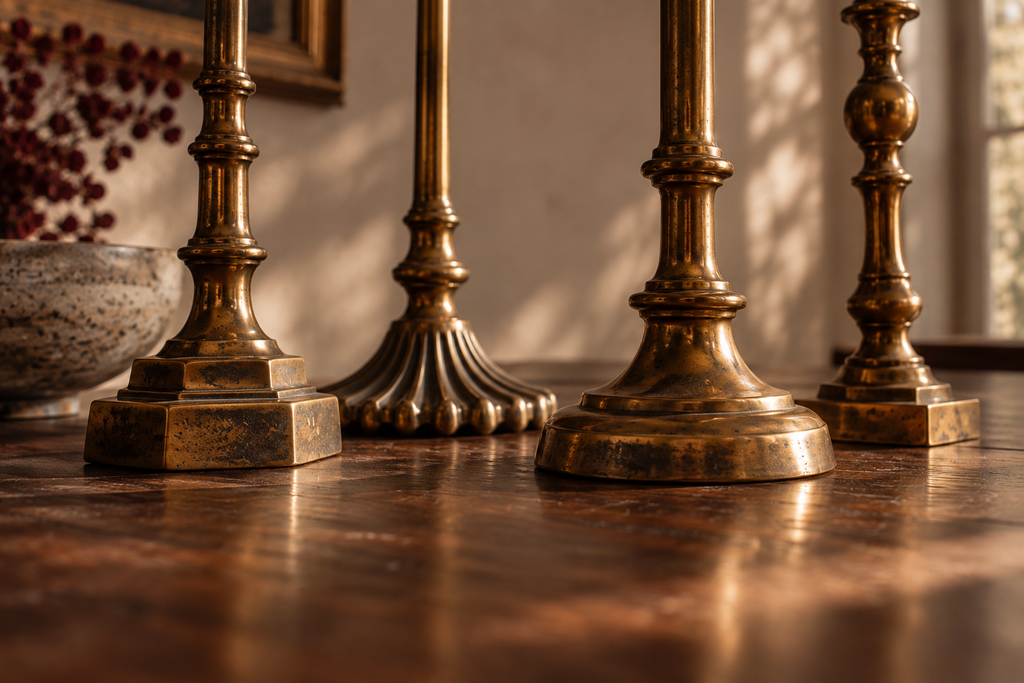
When scanning a shelf full of candlesticks, look at the bases.
This is where some of the best ones reveal themselves.
A stepped architectural foot can make an otherwise simple candlestick feel substantial. A scalloped edge can soften a tall, severe shape. Tiny ball feet can make a familiar form suddenly strange. An octagonal base, shallow drip tray, tripod foot, square pedestal, or exaggerated circular platform can completely change the personality of the object.
Then follow the form upward.
Look for:
- fluted sections;
- twisted stems;
- exaggerated collars;
- sculptural transitions;
- unusual candle cups;
- restrained engraving;
- unexpected curves;
- small asymmetries or evidence of hand finishing.
You are looking for the detail you will remember.
Not every candlestick needs ten interesting features. One genuinely good feature can be enough.
Perfect Pairs Are Lovely. Mismatched Sets Can Be Better.
There is something satisfying about finding a true pair of candlesticks.
They bring symmetry to a mantel, dining table, or sideboard and are particularly useful when you want a room to feel composed.
But do not let the hunt for matching pairs stop you from buying a brilliant single.
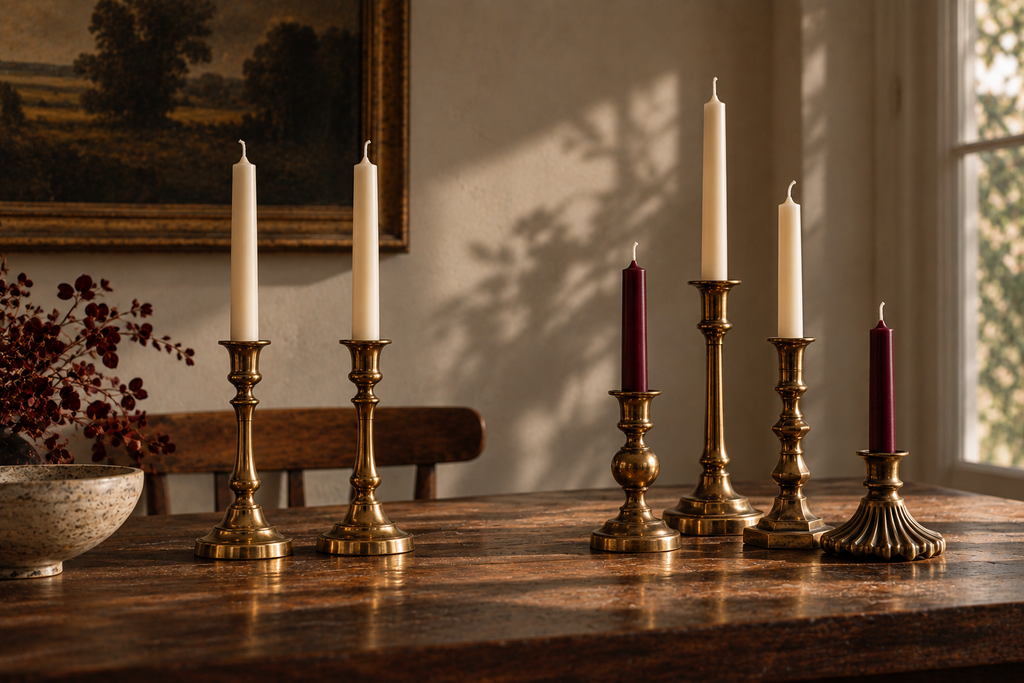
Mismatched brass works because the material itself creates continuity.
You can vary height, age, silhouette, finish, and decorative style while keeping the group visually connected through that repeated warm metal.
The trick is to create rhythm rather than randomness.
Try placing a very slender candlestick beside a shorter, wider one. Repeat approximately the same height somewhere else in the group. Mix a more ornate piece with something almost severe. Let darker aged brass sit beside slightly brighter brass rather than forcing every finish to match.
A useful rule is:
Repeat the material. Vary the silhouette.
This also makes collecting much more enjoyable because you never need to find the whole set at once.
Old Is Not Automatically Better Than New
Vintage and antique candlesticks have obvious appeal.
They may carry years of surface change, have proportions that are difficult to find in current mass-market collections, or show small irregularities that make them feel less generic.
But Weekend Hunt is not an antiques-only exercise.
A new candlestick can be every bit as hunt-worthy.
Independent makers and small homeware brands can offer hand-cast or hand-finished pieces with beautifully resolved forms. Contemporary designers can take brass in directions that older candlesticks never did. Even mainstream stores occasionally produce a piece with unusually strong proportions or a genuinely interesting silhouette.
The same goes for reproductions.
A reproduction does not become good because it successfully pretends to be old. It becomes good when the material, scale, proportions, finish, and detailing work on their own.
Instead of asking only, Is it old?
Ask:
Would I still want this if nobody told me when it was made?
That question is much harder for a mediocre object to survive.
Handmade Pieces Deserve a Different Kind of Attention
When you come across work from an independent metalworker, small foundry, or artisan studio, look for the things that mass production tends to smooth away.
Subtle variation between pieces. Evidence of casting. Slightly irregular surfaces. Hand-finishing. Shapes that would be too strange or too specific for a large homeware collection.
Those details do not automatically justify a higher price, but they can explain one.
A more expensive candlestick begins to make sense when you are paying for genuinely good material, skilled making, original design, difficult casting, unusual scale, or an object that feels as much like a small sculpture as a candle holder.
Pay more for something you can actually identify as special.
Not simply because the listing says “artisan,” “vintage,” or “heirloom.”
When Is It Worth Paying More?
There is no useful universal price for a “good” brass candlestick.
A flea-market single, handmade contemporary piece, signed designer object, and large antique pair are not competing in the same category.
Instead, look at what the extra money is buying.
Exceptional silhouette is worth something.
So is unusually good craftsmanship, substantial material, a genuinely beautiful pair, a distinctive scale, thoughtful hand finishing, or a piece you are unlikely to find an equivalent version of next weekend.
Condition matters too, particularly when the price climbs.
Check that the candlestick sits securely and does not wobble excessively. Look for cracks, loose joins, severe dents, damaged candle cups, unstable bases, or repairs you are not comfortable with.
If you are buying online, look closely at photographs of the underside, edges, joints, and areas of wear rather than relying on the styled hero image.
And if provenance, maker, age, or material is being used to justify a significant price, those claims deserve more scrutiny than they do on a charming inexpensive decorative find.
A Cheap Candlestick Can Still Be an Excellent Find
Price and interest are not the same thing.
A very inexpensive candlestick can earn its place because it has the perfect tall, narrow silhouette your collection was missing. Perhaps the patina is unusually beautiful. Maybe the base is slightly odd. Maybe it is the short, heavy piece that makes five other candlesticks suddenly work together.
That is the point of developing an eye.
You stop asking whether something looks expensive and start asking whether it looks good.
Interesting beats expensive.
There is also a useful freedom in inexpensive finds: they allow a collection to grow organically instead of turning every purchase into an investment decision.
The only real danger is letting “cheap” become the reason you buy something you would otherwise leave behind.
Build the Collection One Good Piece at a Time
You do not need six brass candlesticks by Saturday afternoon.
Start with one you genuinely like.
Later, look for something taller.
Then perhaps something unusually wide or low.
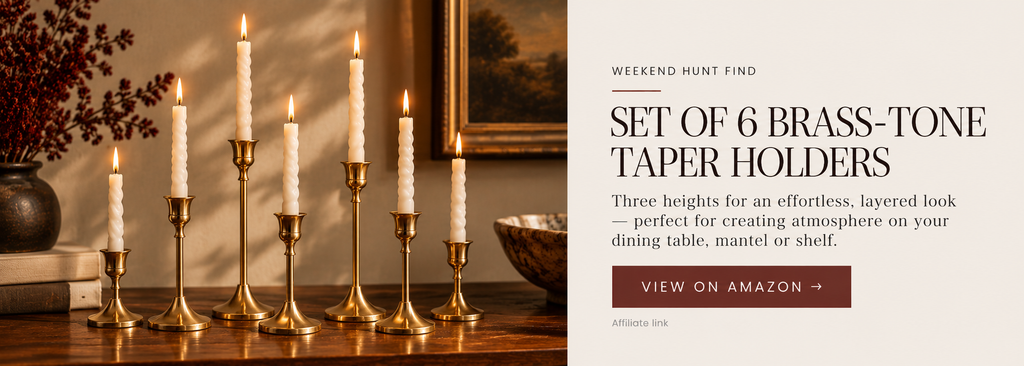
Add a pair when you find a particularly good one. Introduce one sculptural piece. Let the finishes vary slightly. Allow the collection to take shape around what actually appears rather than deciding in advance that you need exactly three tall candlesticks and three short ones.
The gaps are useful.
They stop the hunt from becoming a haul.
If the candlestick in your hand is merely acceptable, leave the space open for the one you will be excited to find three months from now.
Where to Look for Brass Candlesticks
Almost anywhere that sells objects for the home.
That can mean antique stores, flea markets, vintage shops, estate sales, independent homeware stores, artisan markets, design shops, small makers, and ordinary mainstream retailers.
Online, widen the hunt too.
Search Etsy and secondhand marketplaces, but also independent retailers, specialist vintage dealers, small brands, maker websites, and the new-arrivals pages of stores you already like.
Do not limit yourself to searches for “antique brass candlestick,” either.
Try related descriptions such as brass taper holder, cast brass candle holder, sculptural candlestick, vintage brass candle holder, chamberstick, or handmade brass candlestick.
Different sellers name the same kinds of objects differently.
The source matters less than the object.
Christmas Is a Good Moment for Brass — Not Its Only Moment
Brass becomes particularly easy to notice toward the end of the year.
Its warmth works beautifully with dark walnut, deep burgundy, evergreen, mossy greens, ivory candles, waxy off-whites, and the low light of late fall and winter.
At Christmas, you really do not need to do much.
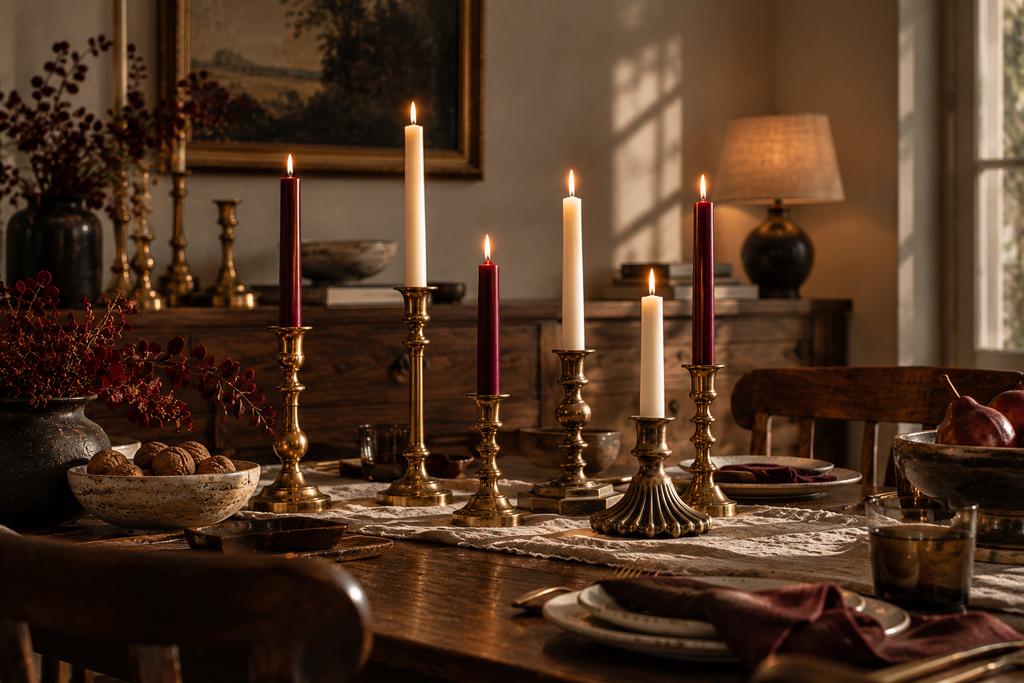
A few brass candlesticks at different heights, deep burgundy or ivory tapers, and a restrained branch of greenery can be enough for a dining table or mantel. A collected group often feels richer than a large amount of explicitly Christmas decor.
Then January arrives.
Remove the greenery.
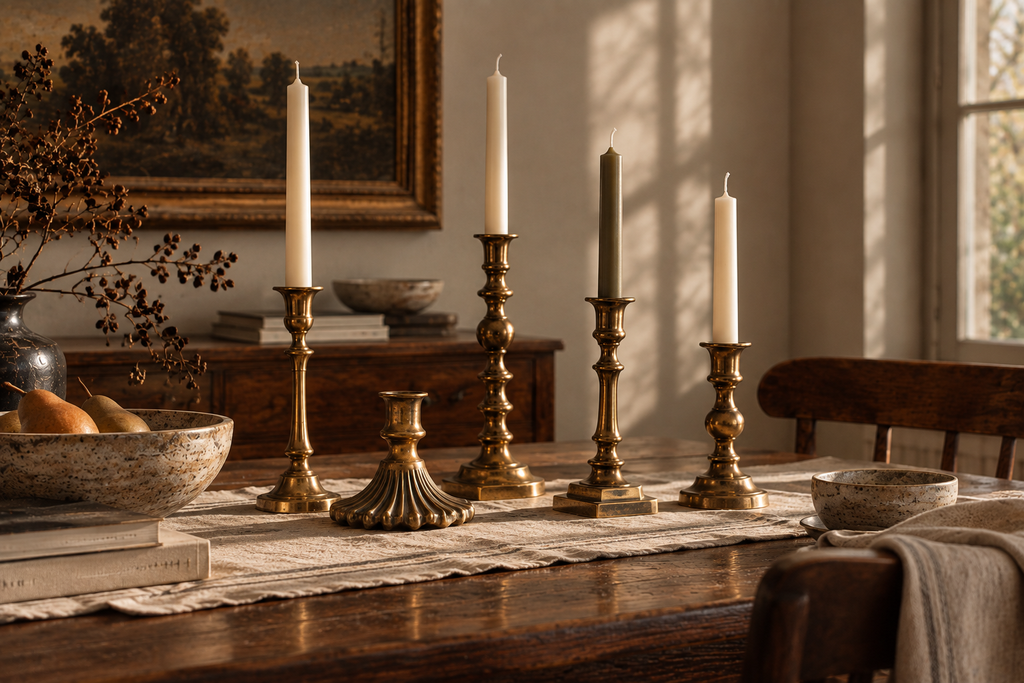
Swap burgundy for warm white, ivory, beeswax, muted olive, or even charcoal candles.
Leave the candlesticks exactly where they are.
They can move between a dining table, mantel, sideboard, console, shelf, or bedside surface throughout the year. A beautiful candlestick does not need a holiday to explain why it is there.
The Weekend Hunt Test
Before taking the next brass candlestick home, give it a few seconds.
Ask yourself:
- Would I notice its silhouette from across the room?
- Do the proportions feel resolved?
- Does the material or finish make the shape better?
- Is there one detail I will remember?
- Does it add something my existing pieces do not?
- Would I still like it once the Christmas decorations are gone?
- Does the price make sense for what is actually special about the object?
It does not need to pass every question.
But if the only reason you are still holding it is that it is brass, vintage, or cheap, put it back.
There will be another one.
The Best Collections Are Not Bought All at Once
That may be the best thing about brass candlesticks.
You can find the first one this weekend and the next one six months from now.
One might come from an antique shop. Another might be handmade by someone you discover online. One could cost very little. Another might be the piece you decide is worth saving for.
They do not need to share a decade, maker, or exact finish.
They just need to be good enough that you noticed them.
Because the Weekend Hunt is not really about where something comes from.
It is about developing the eye to recognize it when it appears.
The best collections are rarely bought all at once. They are noticed, one good piece at a time.