

There is a particular kind of thrift-store artwork that is very easy to dismiss.
A faded floral print. A landscape that feels a little too dated. A reproduction you would never choose for your own walls.
You pull it halfway out of the rack, look at the picture, and start to put it back.
But next time, look one layer further out.
The narrow dark-wood edge. The softly worn gilt. The unusual oval shape. The deep molding you rarely see on inexpensive new frames. The warm cream mat that somehow makes everything around it look more considered.
Sometimes, the artwork isn’t the find at all.
The frame is.
And once you start looking at thrift-store art this way, the entire aisle changes.
Start by ignoring the art for a second
This is probably the simplest trick for getting better at finding vintage picture frames: mentally remove whatever is currently inside them.
Would you still pick up the frame if it were empty?
Try looking only at its proportions, shape, material and finish.
Imagine a black-and-white photograph inside it. A small abstract print. A child’s drawing. A piece of contemporary photography. Something you already own and have never quite known how to display.
Suddenly, that deeply unremarkable landscape may look a lot more interesting.

In fact, bad art can occasionally work in your favor. If everyone else is judging the object entirely by the picture, a beautiful frame can sit unnoticed for weeks.
That is exactly the kind of thing The Weekend Hunt is for.
Not finding more stuff.
Learning to notice the good thing everyone else walked past.
Solid wood deserves a second look
You don’t need to become an antique-frame expert before Saturday morning.
You do, however, want to start noticing materials.
Pick the frame up.
Does it have some weight to it? Can you see real wood grain along the back or edges? Are the corners joined cleanly? Does the molding feel substantial rather than hollow or lightweight?
Older decorative frames can also be more complicated than they first appear. Historic gilded examples, for instance, may combine a wooden structure with gesso, applied ornament and gilded surfaces rather than being carved entirely from one piece of wood. Smithsonian conservation resources document precisely this kind of layered frame construction.
So the rule isn’t simply:
carved = good, molded = bad.
It is more useful to ask whether the materials, proportions and construction make the object feel worth keeping.
You are looking for character, not an authentication test.
Look for shapes that are surprisingly difficult to find new
Rectangles are everywhere.
Interesting rectangles are not.
One of the pleasures of shopping secondhand is finding proportions that don’t seem to exist in the standard frame section anymore.
Keep an eye out for:
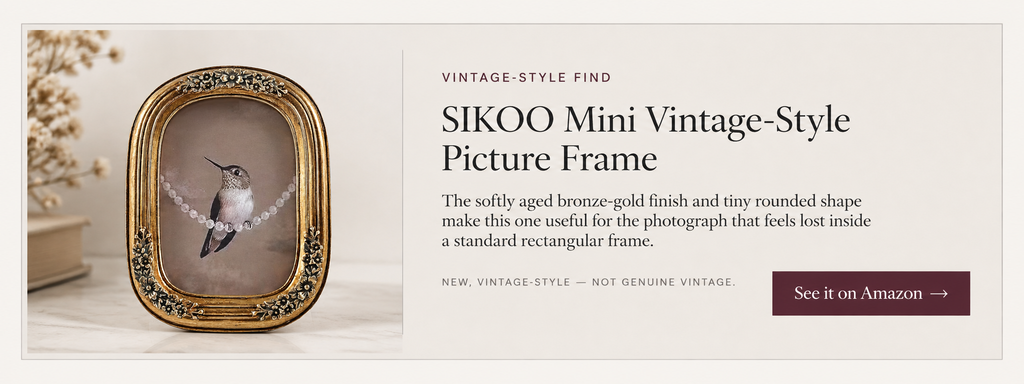
- small oval portrait frames
- long, narrow rectangles
- deep wood moldings
- unusually wide mats
- tiny frames with beautifully scaled borders
- subtle curved profiles
- oversized frames with relatively small openings
You don’t need elaborate ornament for a frame to feel special.
Sometimes it is simply the ratio between the border and the artwork that makes it look different.
And because frames take up relatively little storage space, this is one of those categories where buying a genuinely good example before you know exactly where it will go can make sense.
Within reason, obviously.
We are hunting, not hauling.
Let gilt look a little old
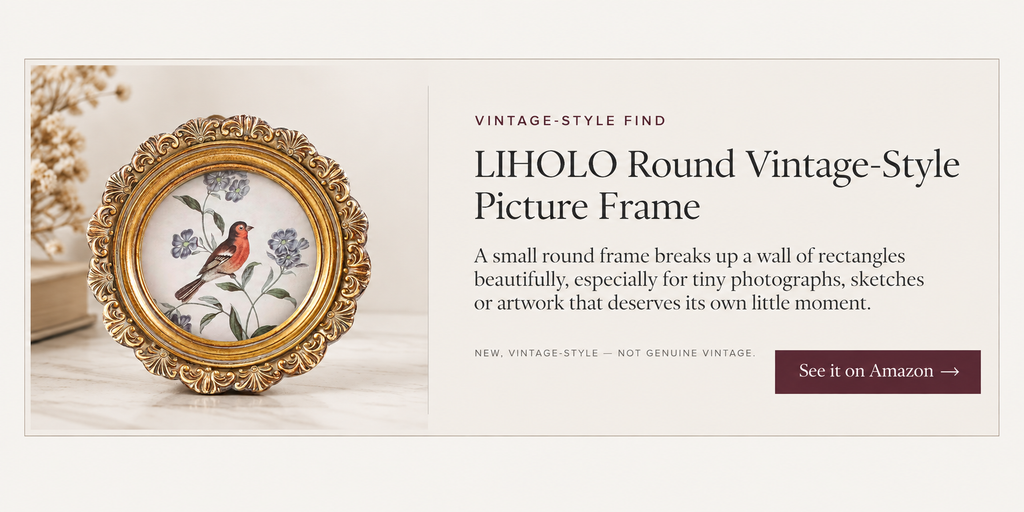
A vintage frame does not need to look freshly manufactured to be beautiful.
In many cases, the reason it works is because it doesn’t.
A little rubbing along the corners. Slight variation in the gold tone. Dark wood that has mellowed. Brass that has lost its showroom shine.
Those small imperfections can make a very simple contemporary print feel less flat and a room feel as though it developed over time rather than arriving in one delivery.
The distinction to make is between patina and damage.
A softened finish is one thing.
Loose ornament, crumbling gesso, badly separated corners or areas actively flaking away are another. Frame conservators specifically assess structural integrity and surface condition because deterioration of these decorative layers can require specialist treatment.
You don’t have to reject every imperfect frame.
Just be honest about whether you’re buying charming wear or somebody else’s restoration project.
Turn it over before you decide
The back of a thrift-store frame will often tell you more than the front.
Before taking one home, check:
- Are the corners stable?
- Is the hanging hardware secure?
- Is the backing intact?
- Is the glass chipped?
- Does anything feel loose when you move it?
- Can the existing picture actually be removed without destroying the frame?
- Is it a standard-ish size, or will everything going inside it require custom cutting?
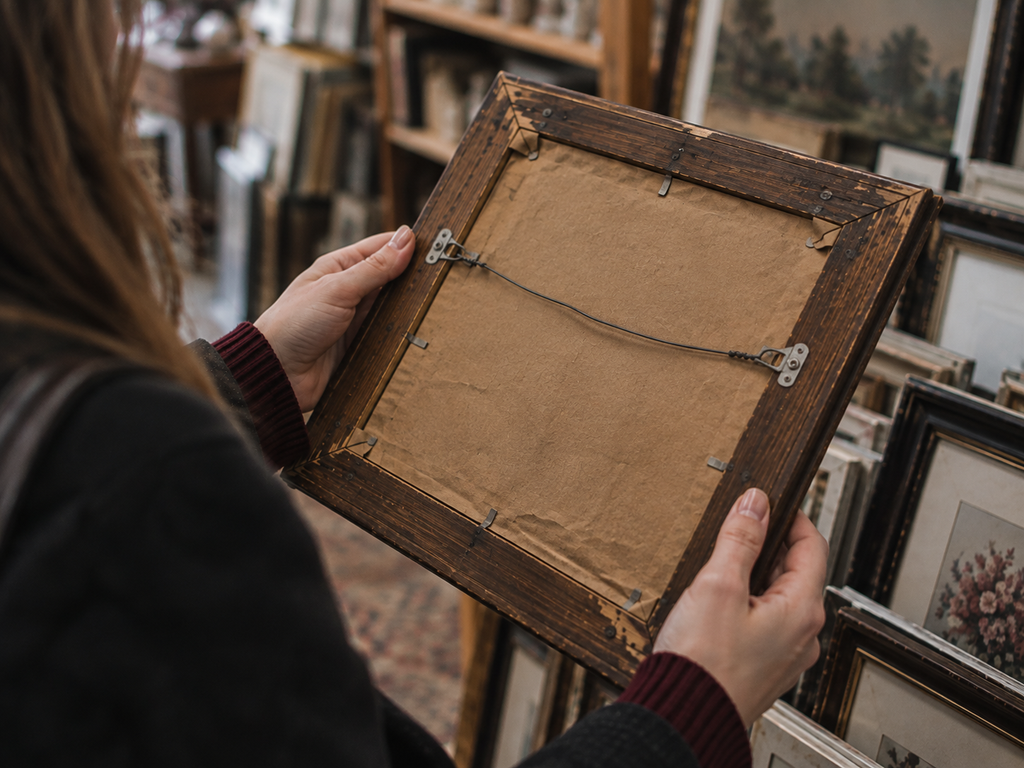
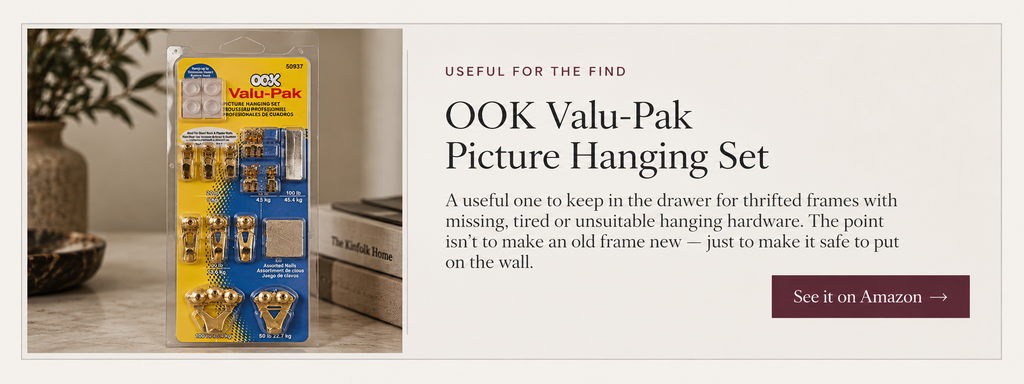
You don’t need pristine hardware. Hooks and backing materials can often be replaced.
What matters more is understanding what you’re taking on.
A $7 frame that needs a new hanging wire is still a $7 frame with an easy fix.
A $7 frame that needs structural repair, custom glass, new matting and half a weekend of work may be a different proposition.
Unless, of course, it is an exceptional frame.
Then we’re all capable of becoming slightly less rational.
Don’t automatically throw away the mat
We have become very good at replacing things before deciding whether they actually need replacing.
The mat inside an older frame is a good example.
A warm cream mat can look much better with dark wood or aged gilt than a bright white replacement. Slight mellowing may even be part of what gives the frame its character.
So before removing everything, put the frame somewhere with decent daylight and look again.
Could the existing mat work with different art?
Could you simply cut a new opening?
Is the warmer color actually helping?
There is, however, a difference between softly aged and genuinely damaged.
If the mat is heavily stained, warped, moldy or touching an artwork you care about, replace it with appropriate new materials.
The point isn’t to preserve every old component at all costs.
It is to stop automatically assuming that newer means better.
Buy the frame even if you don’t know what belongs inside it yet
This goes against a lot of sensible shopping advice.
Usually, “I’ll figure out what to do with it later” is how clutter begins.
But there are exceptions.
A genuinely beautiful, versatile vintage frame is one of them.

If the size is manageable, the condition is good and you would happily display the frame itself, you don’t necessarily need to have its final artwork decided before bringing it home.
Frames move.
The little oval that begins in a hallway might eventually hold a family photograph beside the bed.
The dark wood rectangle you bought for an art print might end up framing one of your own photographs.
The oversized gilt frame might sit empty against a wall for three months before you find the thing that makes sense inside it.
A slowly collected home sometimes requires leaving a little room for that process.
What do you actually put inside an old frame?
Almost anything.
And this is where the contrast gets interesting.
An older frame doesn’t require older art.
In fact, the tension between the two can be exactly what makes it work.
Try:
- contemporary photography
- inexpensive art prints
- small original paintings
- sketches
- family photographs
- postcards from somewhere meaningful
- children’s drawings
- textile fragments
- simple graphic prints

You can even have mirror glass cut for a particularly good empty frame.
The important part is not to make every choice feel historically “correct.”
A highly decorative gilt frame around something restrained and modern can feel much fresher than trying to recreate the room the frame might originally have lived in.
You don’t need six matching ones
Please don’t feel obliged to turn your first good thrifted frame into an immediate gallery-wall project.
Let the collection happen slowly.
One dark wood frame.
Months later, a narrow brass one.
Then perhaps a small gilt oval.
They don’t have to match.
What makes a group feel intentional can be much subtler: similar mat colors, repeated dark wood, two aged-metal finishes, artwork with related tones, or simply enough breathing room between each piece.
A collected wall should look as though the objects found one another gradually.
Because ideally, they did.
Know when to leave one behind
The fact that something is old, cheap or secondhand does not automatically make it a good find.
Leave the frame behind if the corners are seriously separating.
Leave it if decorative material is actively crumbling away and you have no intention of restoring it.
Leave it if the dimensions are so awkward that you’ll immediately need expensive custom work for a frame you don’t actually love.
Leave it if you’re only picking it up because it costs almost nothing.
And leave it if what initially looked like beautiful age starts looking more like factory-made “vintage effect” once you get closer.
There will be another frame.
That is part of the hunt too.
One small caution before you take the artwork out
Most thrift-store prints will turn out to be exactly what you assumed they were.
But occasionally, you won’t know what you have.
If the artwork itself appears genuinely old, signed, unusual or potentially valuable, don’t immediately start pulling out nails, peeling off backing paper or cleaning the surface at home.

Conservation guidance recommends examining framed works carefully before removal because poor handling can damage both paper works and paintings; the Smithsonian also advises handling paintings only when both the artwork and frame are stable.
When something gives you reason to hesitate, hesitate.
Research it first.
The thrift-store victory is significantly less satisfying if you accidentally destroy the interesting part on your kitchen table.
The frame aisle looks different once you know what you’re looking for
That might be the best part of learning to thrift well.
The store doesn’t change.
Your eye does.
What used to look like twenty rows of dated artwork becomes dark walnut, old gilt, unusual proportions, soft cream mats and one beautifully narrow frame hidden behind a motivational print from 2009.
You stop asking only:
Do I like this picture?
And start asking:
Would I buy this if the frame were empty?
Sometimes the answer will still be no.
But every so often, you’ll pull out the terrible painting, look at what surrounds it and realize you’ve found exactly what you came for.
Even if you didn’t know you were looking for it.
Look carefully. Bring home less. Make the find count.