

You don’t need a cortisol detox, a 5 a.m. routine, or another list of things to optimize. You might just need a weekend that asks a little less of you.
By the time Friday evening arrives, you are tired enough to want nothing more than two completely empty days.
And then the weekend starts.
There are groceries to buy. Laundry to catch up on. People you have been meaning to see. A workout you feel like you should do. The kitchen could use a reset. You should probably meal prep. Maybe get outside. Drink more water. Put your phone down. Read something. Stretch. Sleep eight hours. Prepare for Monday.
Somewhere along the way, even relaxing starts to feel like another project.
Which is partly why the idea of a “low-cortisol weekend” is so appealing.
Cortisol has become shorthand online for feeling wired, tired, overstimulated and generally unable to switch off. But cortisol itself is not something your body needs to eliminate. It is an essential hormone involved in things like metabolism, blood pressure, blood sugar and your natural sleep-wake rhythm. It normally rises and falls throughout the day. And despite what the phrase “cortisol detox” suggests, it is not a toxin you can flush out over a weekend. (ColumbiaDoctors)
So this is not a plan for hacking your hormones by Sunday night.
It is something much simpler.
A low-cortisol weekend is a weekend with fewer things demanding something from you.
No tracker required.
First, You Don’t Actually Want “No Cortisol”
The internet has a habit of turning normal biology into a problem to solve.
Cortisol is often called the stress hormone because levels can rise in response to stress. But your body needs it. It also follows a natural daily rhythm, typically being higher around the morning and falling toward bedtime. (ColumbiaDoctors)
That means the goal is not to spend Saturday trying to get your cortisol as low as possible.
And feeling exhausted, puffy, irritable or stressed does not, by itself, tell you that your cortisol is medically abnormal.
What you can do is make your weekend less relentlessly stimulating.
Better sleep, enjoyable movement, daylight, decent food, time away from work and actual opportunities to relax are not a detox. They are simply some of the ordinary things that support healthy daily rhythms and stress management. (ColumbiaDoctors)
The useful question is therefore not:
How do I lower my cortisol this weekend?
It is:
What would make these two days feel less demanding?
1. Start by Taking Something Off the Weekend
Most weekend advice begins by giving you something else to do.
Go for a walk.
Make a healthy breakfast.
Meditate.
Declutter.
Journal.
Take a bath.
Call a friend.
The suggestions may all be perfectly nice. But when you already feel stretched, adding seven relaxing activities to your schedule can be a surprisingly stressful way to relax.
Start somewhere else.
Remove one thing.
Skip the errand that can happen next week.
Say no to the social plan you accepted mostly because you felt guilty.
Don’t deep-clean the bathroom just because it is Saturday.
Leave the returns in the trunk until another day.
Stop treating every unfinished task from Monday through Friday as weekend homework.
Sometimes the fastest way to create a calmer weekend is not to add a soothing activity.
It is to create some empty space for one to happen naturally.
2. Let Friday Night Be a Landing, Not the Main Event
Friday night carries a strange amount of pressure.
You have waited all week for the weekend, so surely you should do something with it.
But after five days of alarms, work, commuting, notifications, decisions and other people’s expectations, you may not need excitement.
You may need a runway.
Order or make an easy dinner.
Put on comfortable clothes.
Have a shower.
Listen to music while you tidy the kitchen.
Watch something familiar.
Sit outside for twenty minutes.
Go to bed because you are genuinely tired.
Research has found differences between workdays and weekends in the cortisol response after waking, with anticipation of the working day associated with an enhanced response in one study. That does not mean Friday night needs a special hormone-lowering ritual. It does suggest something we probably already know intuitively: our bodies and brains notice the difference between being “on” and being off duty.
You do not have to squeeze maximum fun out of Friday.
You are allowed to arrive slowly.

3. Don’t Turn Saturday Morning Into a Self-Improvement Seminar
There is a particular kind of internet Saturday morning that begins before sunrise.
Wake up early.
Make the bed.
Drink something green.
Get sunlight immediately.
Journal.
Meditate.
Stretch.
Hit 10,000 steps.
Eat a perfectly balanced breakfast.
Do your skincare.
No phone.
All before 8:15 a.m.
If you genuinely enjoy that, wonderful.
But you do not need a six-step morning routine to prove that you know how to rest.
Wake up.
Open the curtains.
Make coffee.
Eat breakfast.
Take the dog out.
Sit at the kitchen table longer than you normally would.
Put music on.
Maybe you go for a walk. Maybe you don’t.
A calm morning can just be a morning.
The point is not to perform relaxation correctly. It is to notice how different a morning feels when nobody is rushing you through it.

Bake something slowly – Learn more
4. Move, But Don’t Make Your Body Earn Its Rest
Movement can be one of the nicest parts of a weekend precisely because it does not have to look like weekday exercise.
Take a long walk somewhere you actually like.
Do Pilates.
Ride your bike.
Garden.
Swim.
Walk to get coffee instead of driving.
Spend an hour wandering around a flea market.
Stretch because your back feels better afterward, not because a wellness app told you that stretching is part of your cortisol protocol.
Exercise itself can temporarily affect cortisol, which is another reason the internet’s idea that every healthy habit should simply “lower cortisol” is too simplistic. Columbia endocrinologist Salila Kurra notes that cortisol can increase during healthy activities such as exercise too. (ColumbiaDoctors)
The better weekend question is not whether an activity produces the perfect hormonal response.
It is whether it leaves you feeling better than when you started.
5. Spend Part of the Day Somewhere Your Phone Isn’t the Most Interesting Thing
screen-free things to do – Learn more
You do not need a digital detox.
You do not need to put your phone in a locked drawer for six hours.
Just go somewhere that gives it some competition.
Walk through a neighborhood you like.
Browse a flea market.
Go to the beach.
Sit outside with lunch.
Visit a garden center without needing to buy anything.
Take a book to a park.
Drive somewhere pretty.
Walk the dog somewhere different.
There is an important distinction here: do not turn being outside into another assignment.
You do not need exactly 30 minutes of morning sunlight.
You do not have to track your steps.
You do not need to listen to an educational podcast while walking.
You are allowed to look around.
Sometimes the most restorative version of a walk is the one that accomplishes absolutely nothing else.

This post contains affiliate links. We may earn a commission from purchases made through them.
FOR THE COFFEE YOU’RE TAKING WITH YOU

Paid link
6. Leave One Part of Saturday Completely Unoptimized
This might be the hardest part.
Leave two or three hours without a plan.
Not secretly reserved for errands.
Not a productivity block.
Not “free time” during which you intend to finally organize the pantry.
Actually empty.
Maybe you nap.
Maybe you bake something.
Maybe you start a craft you have been thinking about.
Maybe you watch three episodes of a show.
Maybe you call someone.
Maybe you sit outside until you get bored enough to think of something you genuinely want to do.
Or maybe you do nothing particularly memorable.
That is allowed too.
We have become so accustomed to filling tiny gaps in the day that genuinely unstructured time can initially feel uncomfortable.
But boredom does not mean you are wasting the weekend.
Unstructured time is one of the few things modern life rarely gives us accidentally.
You might have to protect some on purpose.

IF YOU FEEL LIKE MAKING SOMETHING

Paid link
7. Eat Like It’s a Normal Weekend, Not a Hormone Experiment
Cortisol content online has produced an impressive number of drinks, powders, supplements and highly specific morning meals.
You do not need to build your weekend menu around your adrenal glands.
Eat regularly.
Drink water.
Make food you like.
Have brunch.
Cook something slowly because you have time.
Order pizza.
Eat dinner with someone.
Make a proper lunch instead of standing at the counter eating scraps while you clean the kitchen.
There is no single food, supplement or viral drink that “detoxes” cortisol. What medical experts tend to recommend instead are the much less dramatic fundamentals: adequate sleep, a balanced diet, daylight exposure, stress management and other sustainable habits that support healthy daily rhythms. (ColumbiaDoctors)
Useful, yes.
Magical, no.
Your lunch does not need to become endocrine medicine.
8. Don’t Give All of Sunday to Monday
Sunday has a tendency to disappear.
You wake up and suddenly there is laundry running, groceries arriving, lunches being portioned, work clothes hanging over doors and six tabs open because you are checking next week’s calendar.
By late afternoon, Monday has effectively already started.
Some preparation can make the week easier.
But there is a difference between helping Monday-you and sacrificing Sunday-you entirely.
Try giving the reset a boundary.
Instead of vaguely “getting ready for the week” all day, choose a short window later in the afternoon or evening.
Do the things that genuinely remove friction.
Then stop.
Because Monday is going to arrive whether or not every drawer is organized.

Make the week feel lighter – Learn more
A Better Sunday Reset Might Be Three Things, Not Thirty
If you like having a little structure, make it almost ridiculously small.
Choose:
One thing for the house.
Run the laundry. Clear the kitchen counter. Take out the trash. Pick one.
One thing for Monday morning.
Pack your bag. Decide what you are wearing. Make breakfast easier. Check your first appointment.
One thing that still feels like Sunday.
Cook dinner you enjoy. Take a long shower. Watch a movie. Go for an evening walk. Read in bed.
That’s enough.
PREP ONE THING. THEN STOP.
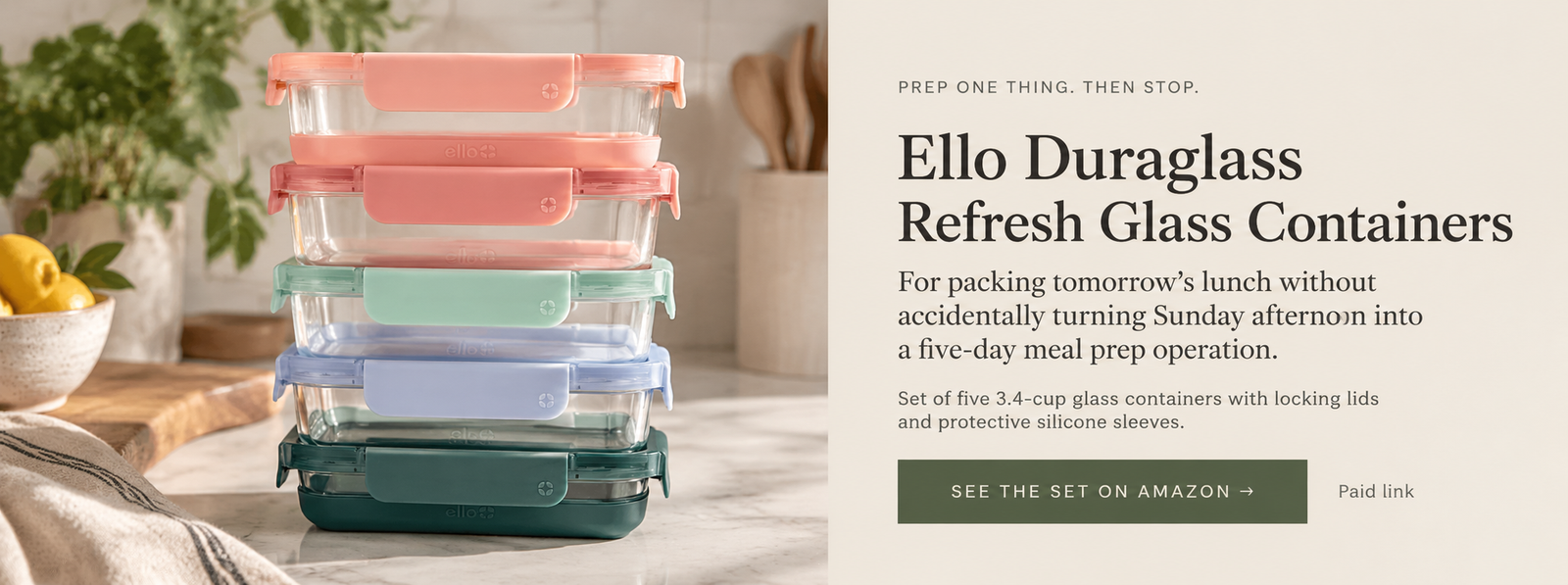
Paid link
You can prepare for the week without turning the final third of your weekend into an unpaid shift.
And If You Still Feel Stressed on Sunday Night?
Sometimes Sunday feels uncomfortable even after a genuinely good weekend.
The familiar “Sunday Scaries” are a form of anticipatory anxiety about the coming workweek. Cleveland Clinic psychologist Kia-Rai Prewitt describes the term as anxiety before the beginning of the workweek and recommends, among other things, focusing on what is within your control, doing things you enjoy and avoiding overloading the weekend itself.
But there is another possibility worth considering.
Maybe the weekend isn’t the entire problem.
If you spend every Sunday with a growing sense of dread, it may be worth looking at what exactly you are returning to.
Too much work.
Constant availability.
A difficult environment.
A workload you cannot realistically finish.
A calendar with no breathing room.
Cleveland Clinic similarly notes that persistent Sunday anxiety can be a reason to examine the working conditions contributing to that stress rather than treating the weekend as the only thing that needs fixing.
Because a perfect evening routine cannot indefinitely solve a Monday problem.
A quiet Sunday-night reset – Learn more
The Goal Isn’t a Perfectly Regulated Weekend
Perhaps you stayed up too late on Friday.
Perhaps Saturday involved more errands than you wanted.
Perhaps you spent an hour scrolling on the sofa.
Perhaps dinner came in a cardboard box.
Nothing has been ruined.
Your weekend is not another system in which you can succeed or fail.
You do not have to emerge on Sunday night perfectly rested, meal-prepped, screen-free, emotionally regulated and ready to attack the week.
You are a person who got two days away from some of your usual obligations.
Let them feel like that.
A low-cortisol weekend, at least in the useful non-medical sense, is less about performing all the right wellness habits and more about reducing unnecessary pressure: fewer demands, fewer decisions, less work creeping into personal time and enough unclaimed space to notice what you actually feel like doing.
Maybe the most useful thing the cortisol conversation can teach us isn’t how to optimize our weekends.
Maybe it is how badly we needed permission to stop optimizing them.

Frequently Asked Questions
What is a low-cortisol weekend?
“Low-cortisol weekend” is an informal wellness phrase, not a medical protocol. A more useful way to think about it is as a lower-stress weekend: less unnecessary pressure, enough rest, enjoyable movement, regular meals, daylight, time away from work and some genuinely unstructured time.
Can relaxing on the weekend lower cortisol?
Stress and anticipation can affect the body’s cortisol response, and studies have observed differences between workdays and weekends. However, cortisol varies naturally throughout the day and from person to person, so a relaxing weekend should not be treated as a medical treatment for high cortisol.
What activities are good for a low-stress weekend?
There is no required list. Walking, enjoyable exercise, spending time outdoors, getting enough sleep, seeing people you like, cooking, reading or simply leaving part of the day unscheduled can all work. Choose activities that feel restorative rather than turning relaxation into another performance.
Is a cortisol detox real?
No. Cortisol is an essential hormone rather than a toxin, so there is no recognized need to “detox” it. Healthy sleep, nutrition, daylight and stress-management habits can support the body’s normal cortisol rhythm.
Why do I feel anxious on Sunday nights?
The “Sunday Scaries” describe anticipatory anxiety about the approaching workweek. If it happens frequently, it can help to look not only at how you spend Sunday but also at the workload, environment or other circumstances you are anticipating on Monday.