
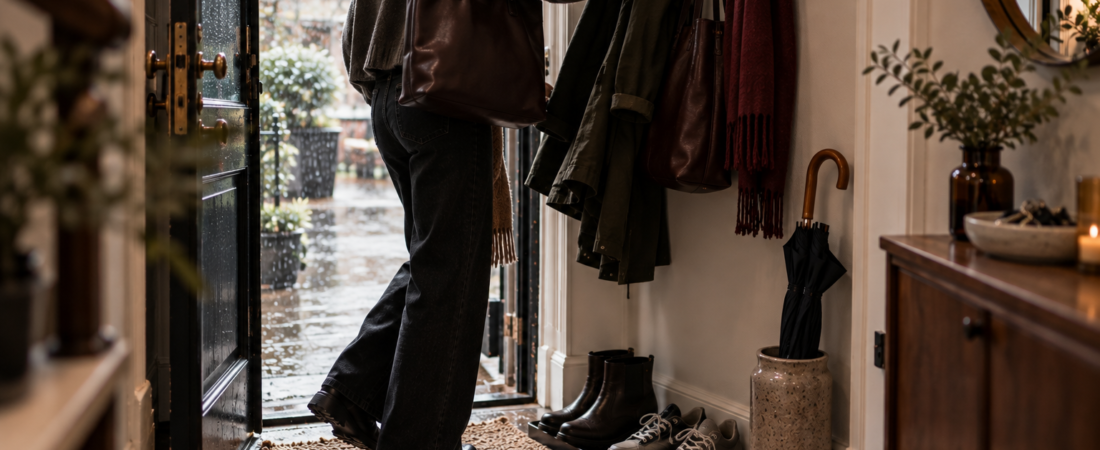
There is a point in early fall when the front door quietly starts doing more work.
The shoes get heavier. Jackets stop being optional. An umbrella appears somewhere near the door and never quite leaves. Dog walks require an extra layer. Bags come home slightly damp. And suddenly the small collection of things that worked perfectly well all summer starts competing for the same few hooks, corners and surfaces.
That is usually the moment when entryway organization becomes less about making the space look tidy and more about making everyday life easier.
You do not need a mudroom, a built-in storage wall or even much of an entryway at all. The useful question is much simpler:
What needs to change by the front door now that the weather has changed?
A good cold-weather reset gives the things you actually use somewhere obvious to land when you come home — and somewhere equally obvious to find them when you leave again.
Affiliate disclosure: This post contains affiliate links, which means After Friday may earn a commission if you make a purchase through them, at no extra cost to you. As an Amazon Associate I earn from qualifying purchases.
Start With What Has Changed
Before moving anything, look at the space as it is now.
What has started appearing here that was not around a month ago?
Maybe it is a raincoat hanging over the back of a chair. An extra pair of boots beside the door. A tote containing gloves, dog-walking supplies and three unrelated receipts. An umbrella leaning against the wall because it has never had an official place to live.
Those small changes are more useful than any generic entryway checklist because they tell you what the space needs to do for your actual routine.
Think of the entryway as a transition zone between outside and home.
When you arrive, you need somewhere for the things you remove, drop or carry inside.
When you leave, you need quick access to the few things that consistently go out with you.
Anything that does not support one of those two movements probably does not need prime space near the door.
Move Out What You Are Not Reaching For Anymore
The easiest way to create more entryway storage is often to stop storing so much in the entryway.
Before adding a hook, basket or organizer, remove the things that made sense during warmer weather but are no longer part of the daily rotation.
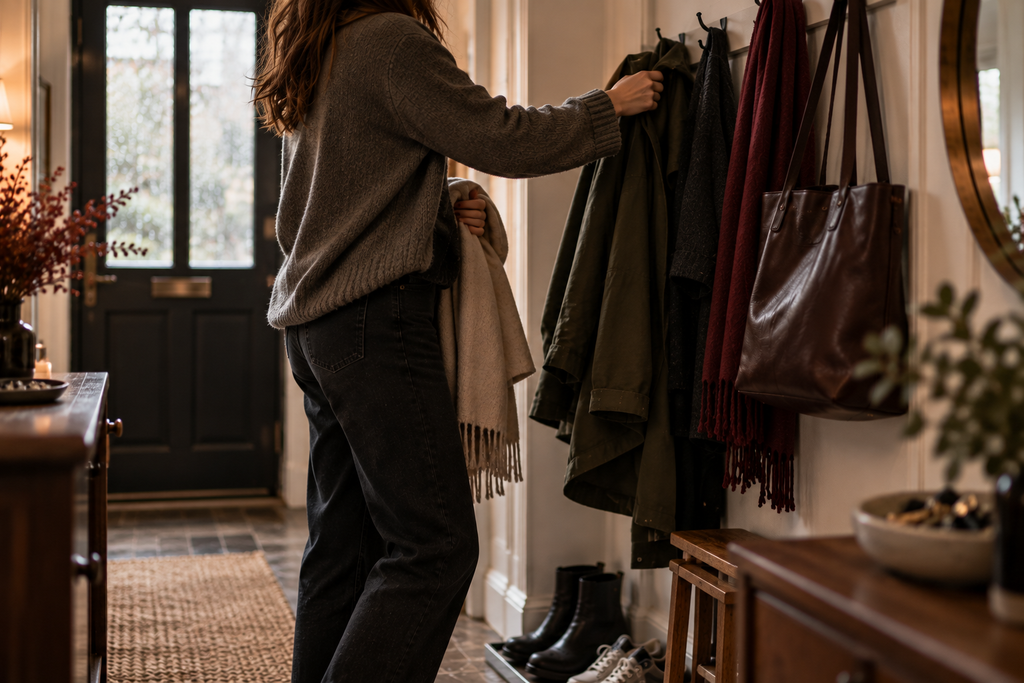
Lightweight shoes you are unlikely to wear again until spring can move elsewhere. The summer tote you stopped carrying does not need to occupy one of three useful hooks. Jackets that are technically outerwear but rarely leave the house can make room for the coat you reach for every morning.
This does not need to become a major seasonal wardrobe project.
You are simply making the space closest to the door reflect what you use now.
That matters even more in a small apartment or narrow hallway. When there is room for four pairs of shoes rather than fourteen, accessibility becomes more useful than completeness.
Keep the everyday rotation close. Store the rest somewhere less convenient.
Make Room for the Outerwear You Actually Wear
Cold-weather coat storage has a habit of expanding until every hook is carrying several layers and finding the one you want requires removing all the others first.
Instead, treat the entryway as short-term parking for outerwear.
Keep the jacket, coat or rain layer you are actively wearing within easy reach. If several people use the space, give each person a realistic amount of hanging room rather than trying to fit an entire seasonal wardrobe by the door.
No coat closet? You still do not need a large freestanding rack.
A few sturdy wall hooks can work in a narrow entry. Over-the-door storage can make use of otherwise empty space. Even one existing hook becomes more useful once it stops holding five things that belong somewhere else.
The goal is not to display every possible layer you might need this season.
It is to make grabbing the right one on a cold morning almost automatic.
Give Wet Shoes Somewhere to Land
Dry-weather shoe storage and wet-weather shoe storage are not quite the same problem.
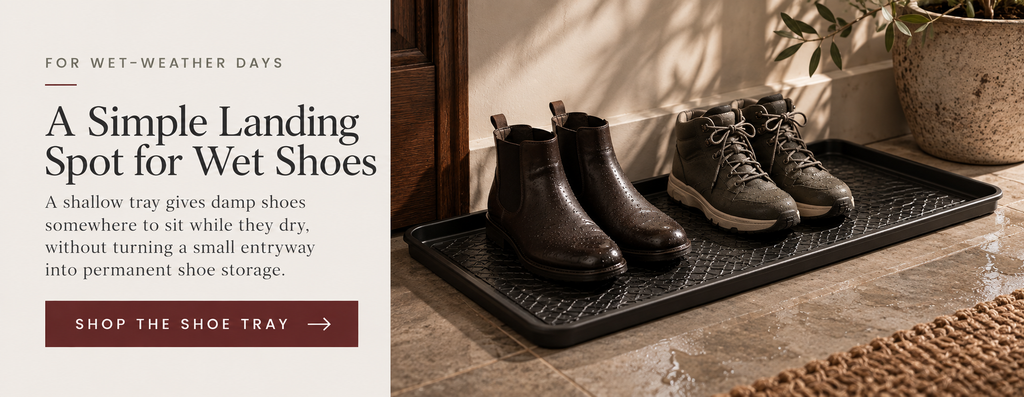
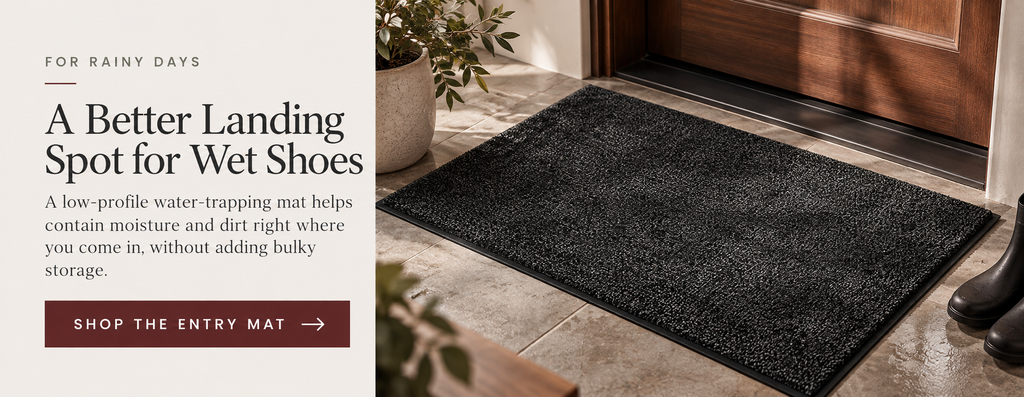
Once rain arrives, the important question is not just where shoes will be stored. It is where they can go immediately after coming inside without leaving water, grit or mud across the floor.
That might be an absorbent mat you already own, a simple shoe tray or one clearly defined section of the floor near the door.
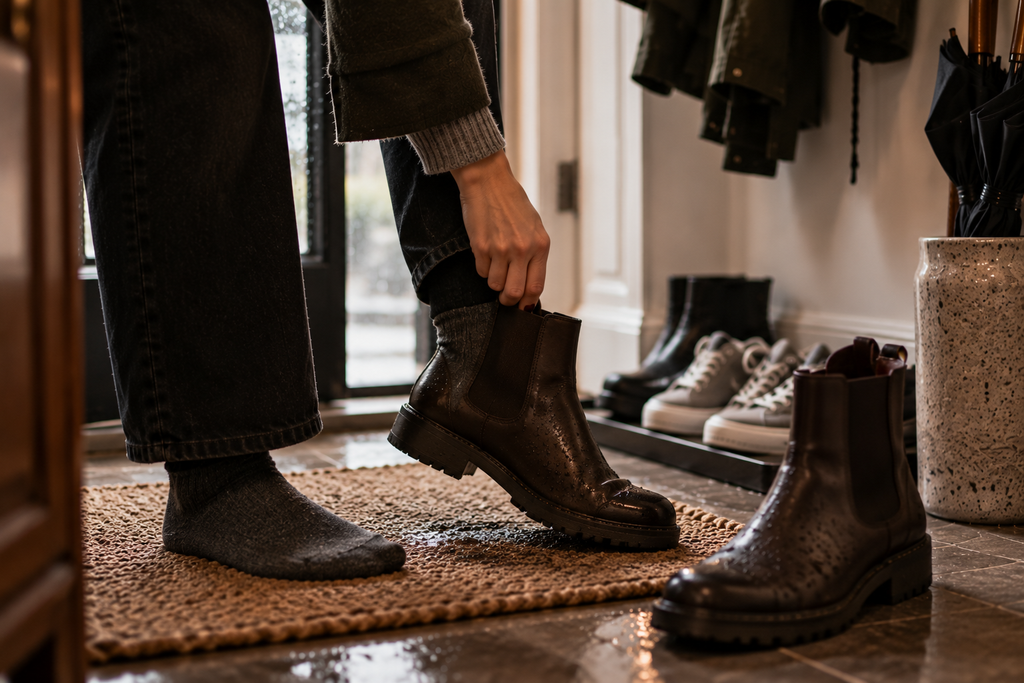
It does not need to hold every pair of shoes in the household.
It only needs enough room for the wet pairs that are currently in use.
If your entryway is tiny, resist filling it with a large shoe-storage solution purely because fall has arrived. A small landing area plus off-season storage elsewhere can work much better than trying to make the front door hold everything.
The best arrangement is the one you can use while carrying groceries, holding a dog lead or arriving home in the rain — without first having to reorganize it.
Decide Where the Umbrella Goes Before It Is Wet
Umbrellas are easy to ignore until there is a dripping one in your hand.
Choose its landing place while everything is dry.
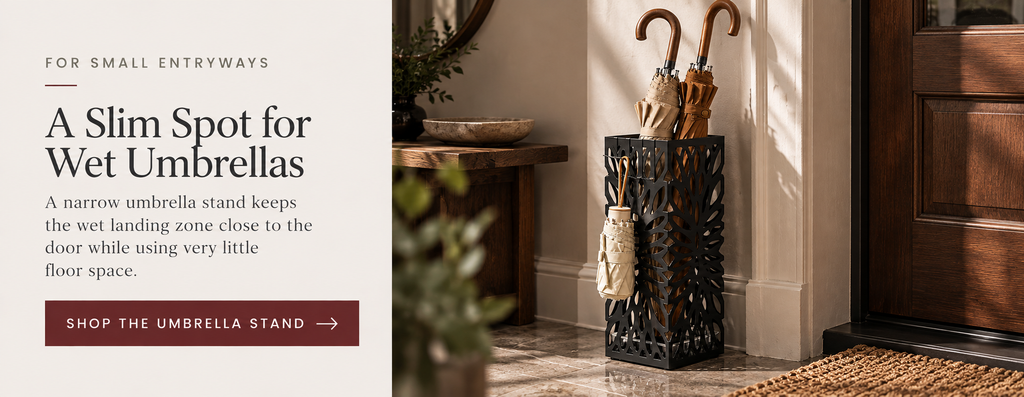
If you have floor space, a narrow umbrella holder can contain the problem neatly. If you do not, the solution can be as simple as a designated spot where an umbrella can stand or hang while it dries without blocking the walkway.
The important distinction is between dry storage and just came in from the rain.
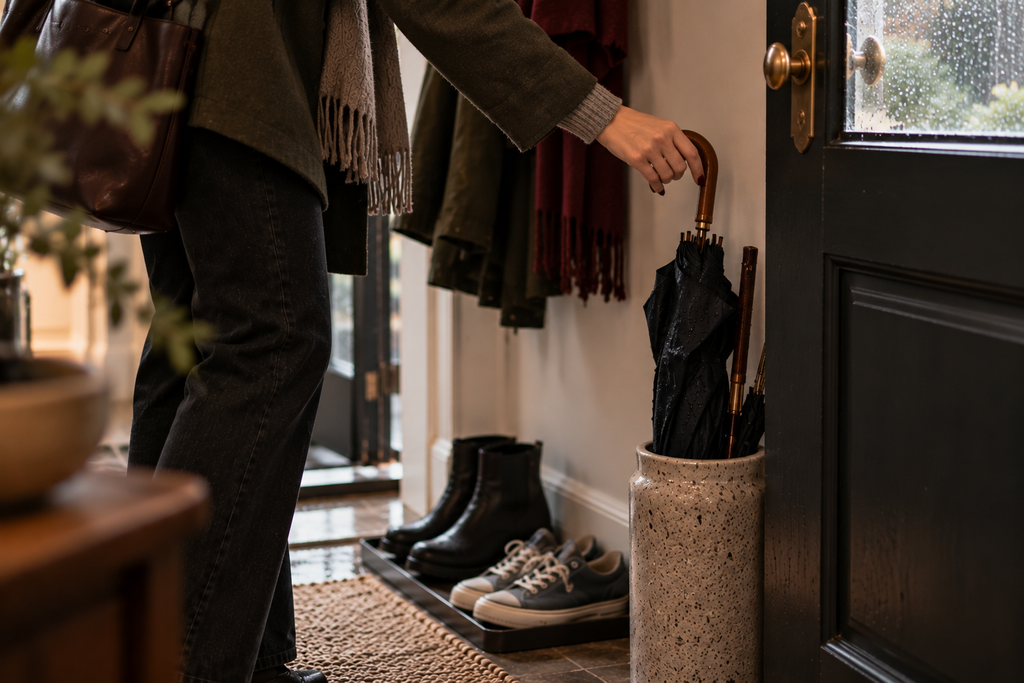
A beautiful basket in a closet may be useful for storing umbrellas, but not if putting a wet umbrella there means dripping across the house first.
The first stop should solve the immediate problem. Once dry, it can move somewhere else if necessary.
Give the Things You Grab Every Day One Obvious Home
Keys are not difficult to organize.
They are difficult to organize when they have six possible homes.
The same is true for an everyday bag, wallet, sunglasses or anything else that regularly travels between home and outside.
Choose one destination for each of the things you repeatedly search for before leaving.
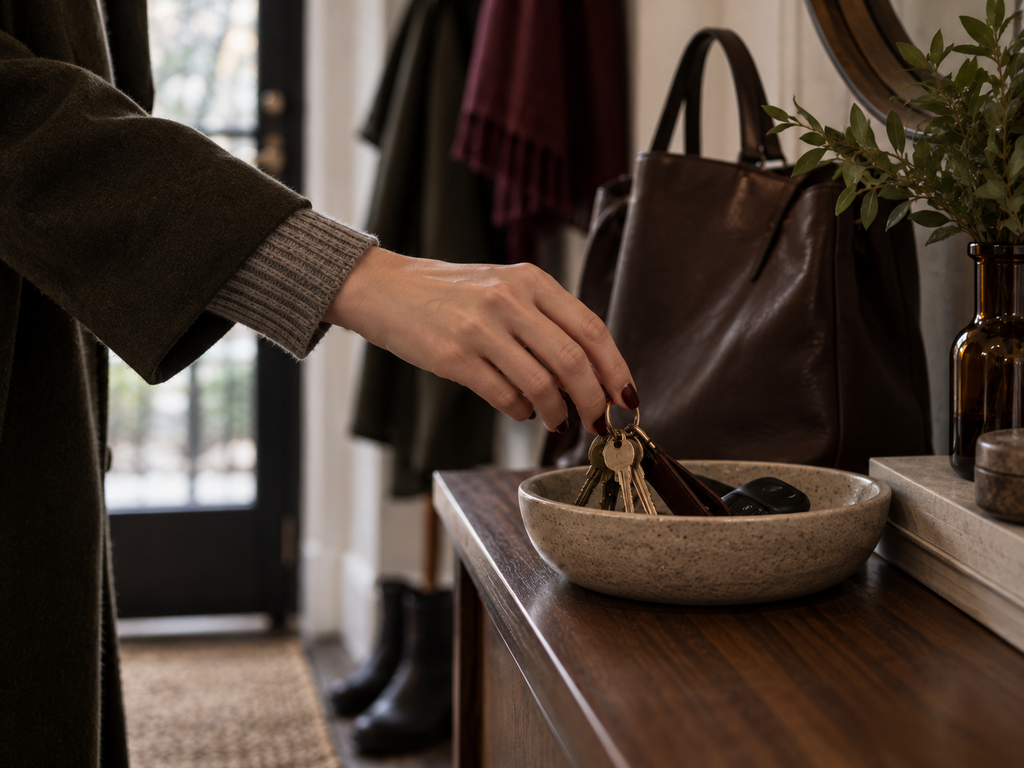
A small catchall on an existing surface may be enough for keys and pocket items. A hook can become the permanent home of the bag you carry most days. If there is no console table, a slim wall-mounted organizer can create a landing place without taking up floor space.
Try not to solve a handful of small objects with a handful of small containers.
The system becomes easier when the destination is obvious enough that you use it without thinking much about it.
Make Dog Walks Easier, If They Are Part of Your Routine
For homes with a dog, the entryway often has another job entirely.
Lead. Harness. Waste bags. A small towel on wet days. Perhaps a coat or light for darker walks.
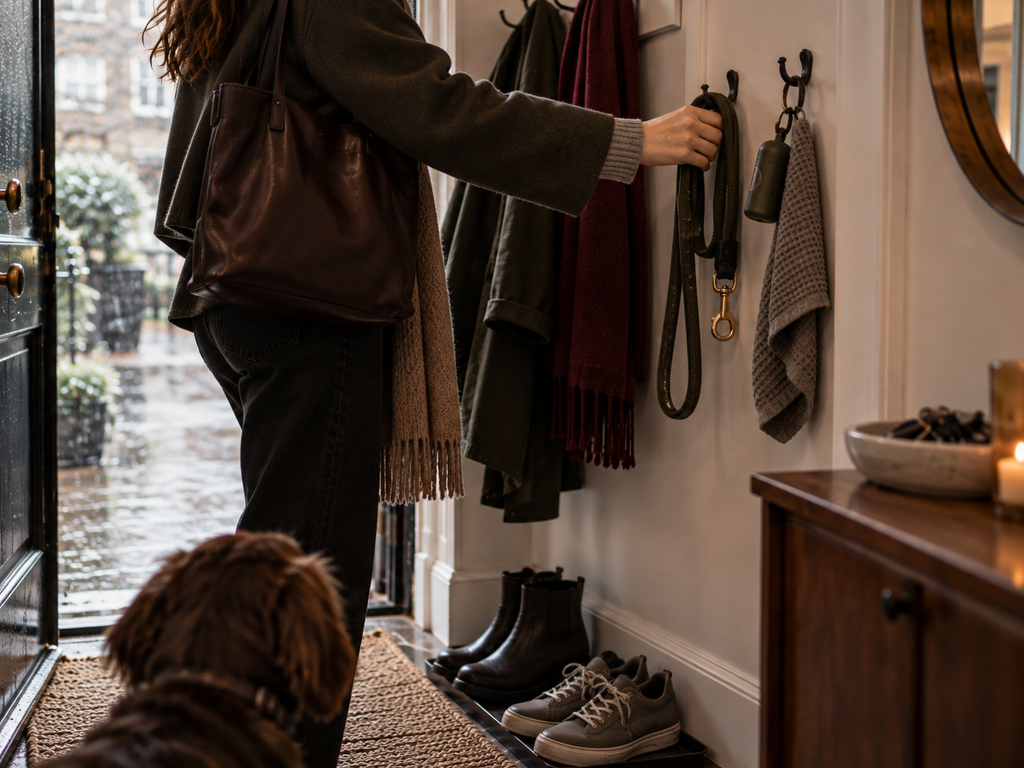
These things do not need an elaborate pet station. They simply need to be close enough to the door that preparing for a walk does not mean gathering supplies from several rooms.
A hook for the lead and harness plus one small place for the extras may be all the system requires.
And if muddy paws are a regular part of colder weather, keeping an old towel near the door can be more valuable than another decorative storage basket.
As with everything else in the entryway, store for the routine that actually happens rather than the one that looks nicest in a photograph.
Stop Incoming Mail From Becoming Part of the Furniture
Mail has a particular talent for becoming a permanent layer of entryway decor.
One envelope arrives. Then another. A receipt joins them. Something needs to be filed, something needs a reply and suddenly the surface beside the door has become an archive.
Instead of creating a bigger place for the pile, make the landing place deliberately small.
Incoming mail only needs somewhere temporary to sit while you decide what happens next.
Recycle what you do not need. Move anything requiring action to the place where you will actually deal with it. File what needs keeping.
If there is no entryway surface, do not create one solely for mail. A wall pocket, existing drawer or another spot just inside the home can perform the same job.
The front door should be the beginning of the mail system, not its final destination.
Keep Cold-Weather Extras Close — But Only the Useful Ones
This is where seasonal organization can quickly turn into seasonal clutter.
Gloves, hats, scarves, reusable shopping bags, hand warmers, umbrellas and other little things all sound sensible near the door. That does not mean every household needs all of them there.
Start with the items you genuinely reach for.
If you regularly forget gloves, keeping your everyday pair near your coat makes sense. If you carry a compact umbrella in your bag all season, give it a consistent place when you get home. If reusable shopping bags repeatedly get left behind, the entryway may be a better home for a couple of them than a kitchen drawer.
But accessibility loses its value when everything is accessible.
Keep the edit small enough that you can see what is there.
No Mudroom? Shrink the System, Not the Idea
Most homes do not have the kind of spacious mudroom that makes seasonal organization look effortless.
Fortunately, none of this depends on having one.
A functional cold-weather entryway can exist on one narrow wall, beside an apartment door or in the first few feet of a hallway.
You need landing places, not necessarily furniture.
A hook can replace a coat rack. A shallow tray can replace a large shoe cabinet. A wall pocket can replace a console. One small dish can handle the things that would otherwise scatter across several surfaces.
And sometimes the best small-space decision is to store something somewhere else entirely.
Your entryway does not have to contain everything associated with leaving the house. It just needs to support the moments immediately before and after you go through the door.
That is a much smaller job.
Do a Quick Leaving-the-House Check
Once you have moved things around, test the entryway from the other direction.
Stand by the door as though you are about to leave tomorrow morning.
Can you find the things you normally need without opening three cupboards or walking back through the house?
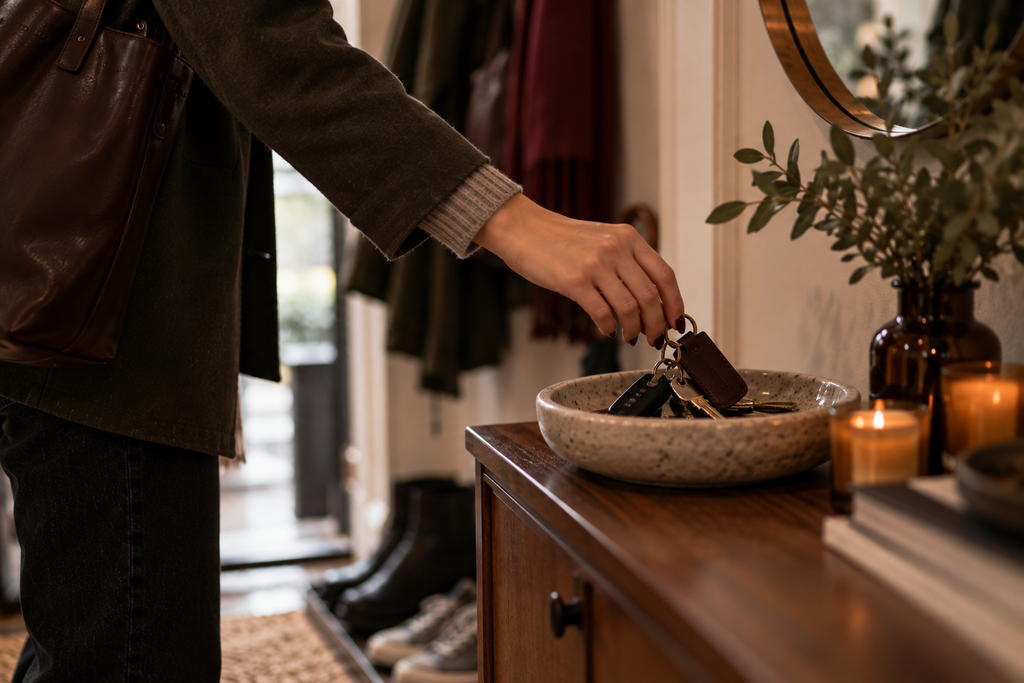
For most households, the check is short:
- keys and everyday bag
- the coat or weather layer you are currently using
- the right shoes
- an umbrella when the forecast calls for one
- dog-walking essentials, if needed
- anything deliberately waiting to leave the house with you
If something on that list repeatedly disappears, it probably needs a clearer home.
If something beside the door never appears on that list and rarely gets used when you come home, it may be occupying valuable space for no reason.
Let the Entryway Change With the Season
A good entryway reset should not feel dramatic.
There may be no satisfying before-and-after reveal. You might not buy anything. The room may look almost exactly the same when you finish.
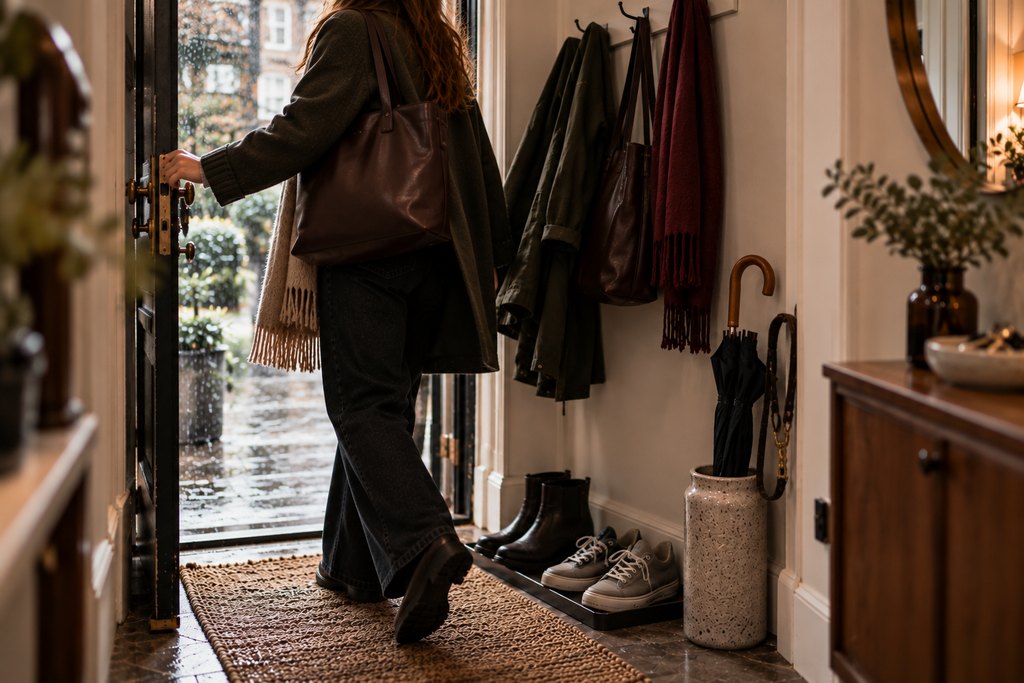
But the next rainy morning, your shoes are where you expect them to be.
You know where the umbrella is.
The coat you actually wear is not buried underneath three others.
The dog lead is ready.
Your keys have not disappeared beneath a pile of mail.
That is the practical side of letting a home shift with the season.
Not redecorating it for fall, but quietly changing the systems around you so they match the way you are living now.
Cold-Weather Entryway FAQ
What should you keep by the front door?
Keep the things you consistently use when leaving or immediately put down when returning home. For many households, that means current-season shoes and outerwear, keys, an everyday bag and an umbrella. Dog-walking supplies or reusable shopping bags may also belong there if they are part of your regular routine. Avoid storing things near the door simply because they might occasionally be useful.
How do you organize a small entryway without a mudroom?
Focus on a few clearly defined landing places rather than trying to add a complete storage system. Use wall space for coats or bags, keep only frequently worn shoes nearby and give keys and other small essentials one obvious home. Anything used less often can live elsewhere in the home.
How do you deal with wet shoes in a small entryway?
Create a small temporary landing area close to the door where wet shoes can dry without tracking water through the home. An absorbent mat, compact shoe tray or clearly designated section of flooring can work. Once the shoes are dry, they can move to their normal storage if space is limited.
Where should you store umbrellas in a small entryway?
Choose somewhere close to the door where a wet umbrella can safely drip or dry. This may be a slim umbrella stand, a hook or another designated spot that does not block the walkway. Dry umbrellas can be stored elsewhere if you do not have room to keep them permanently by the door.
How do you stop coats from cluttering a small entryway?
Keep only the outerwear currently in regular rotation near the door. Move rarely worn and off-season pieces elsewhere, then give the remaining coats enough hook or hanging space that they can be put away easily. In a small entryway, reducing the number of coats is often more effective than adding more storage.